Qube
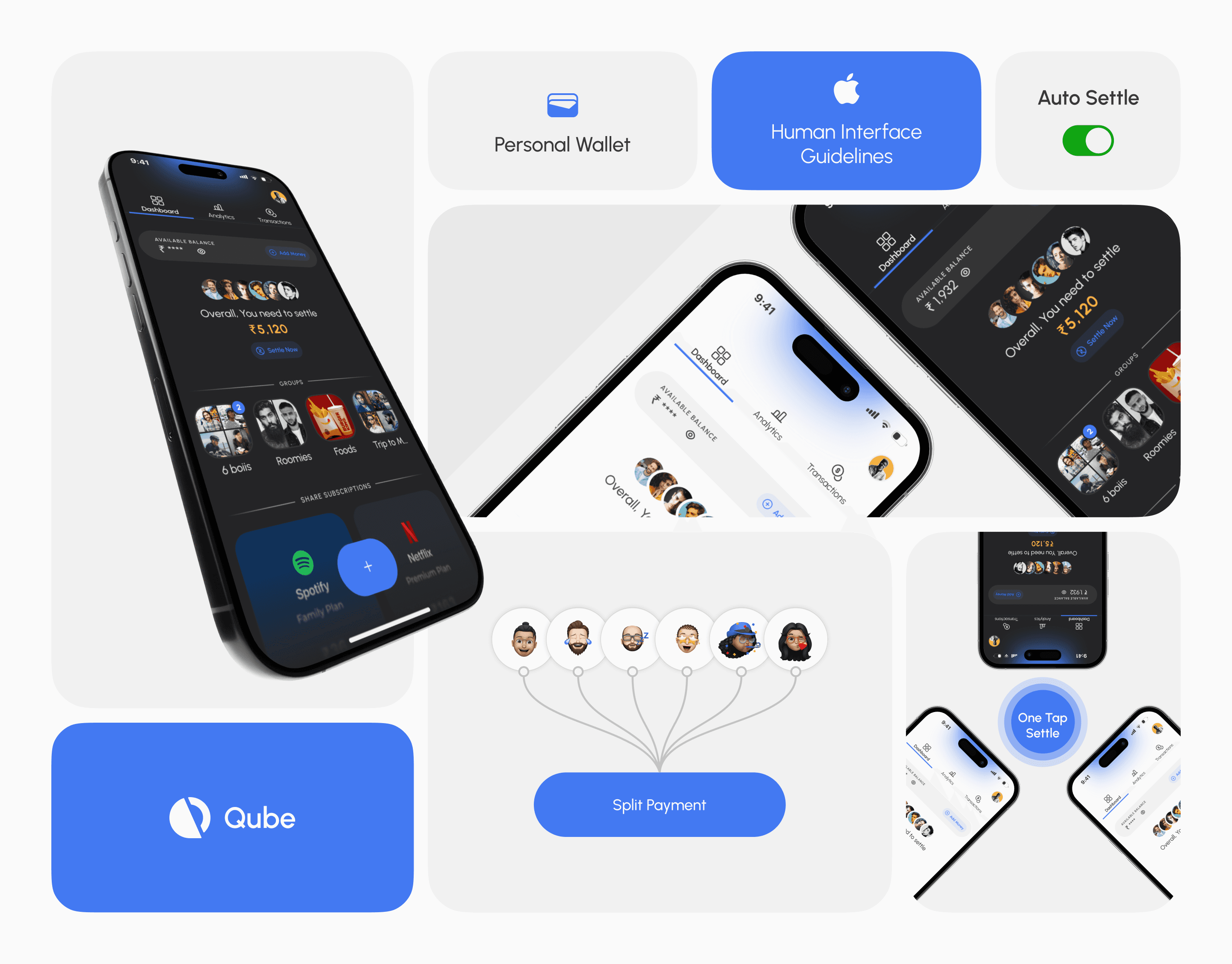
A mobile expense-splitting concept designed to make shared payments easier to track, understand and settle.

Role
UI/UX Designer
UI/UX Designer
Industry
Fintech
Fintech
Project Type
Personal
Personal
Year
2025
2025
Platform
Mobile
Mobile
Tools
Figma · Affinity · Maze
Figma · Affinity · Maze
Contribution
UX Research · Information Architecture · User Flows · Interaction Design · UI Design · Prototyping
UX Research · Information Architecture · User Flows · Interaction Design · UI Design · Prototyping

Problem
Splitting a bill is easy. Keeping track of it isn't.
When a group goes out, the payment itself usually isn't complicated.
The problem starts afterwards.
One person pays for dinner. Someone else pays for a cab. Another person covers the next activity. A few days later, everyone has a different memory of what they owe.
I wanted to understand where this process actually breaks down before designing Qube.
So I asked people how they currently split expenses, how they keep track of balances, what makes them delay payments, and what they expect from an expense-splitting app.
Understanding the problem
I started by looking at two things:
How people currently manage shared expenses, and how digital payment products handle the payment itself.
I ran a small survey with 17 respondents in October 2025. The questions covered how people split expenses, how they record balances, what causes delays, how they remind others to pay, and what they value in an expense-splitting experience.
I also looked at existing research around digital payments and UPI in India. Research on payment apps highlights convenience and ease of use as important factors, while research on UPI describes peer-to-peer transfers and collection requests as part of the payment system.
This gave me a useful distinction:
The payment is already a familiar interaction.
The harder part is maintaining the shared expense before and after the payment.
The Real Problem
Shared expenses don't end when the bill is divided. The balance keeps changing as people add expenses, make payments, forget what they owe, and settle later.
In the survey, 10 of 17 respondents said remembering who owes whom was a frustration. Another 10 of 17 mentioned delayed payments or reminders.
This shifted the focus of Qube from simply calculating bills to keeping the group's financial state clear.
What people are doing today
Looking beyond the bill
I wanted to understand what happens after a shared expense is created.
Not just:
How do people split ₹2,000?
But:
How do they remember what happened afterwards?
The survey asked respondents about their current methods, frustrations, payment behaviour and expectations from expense-splitting apps.
The sample was small, so I treated the results as directional rather than representative.
Most solutions are still pretty simple
People weren't relying on one consistent system.
Some used finance apps. Some used notes. Some relied on memory. Others used payment apps or simply agreed on the amount verbally.
That matters because the problem isn't necessarily that people have no way to record an expense.
The problem is that the information can become fragmented.
One expense might live in a payment app.
Another might be in a note.
Another might only exist in someone's memory.
The result is that the group doesn't always have one clear view of the current balance.
The biggest friction wasn't the calculation
It was remembering the state of the expense
The strongest pattern in the responses was around remembering and settling.
10 respondents selected “Hard to remember who owes whom.”
Another 10 selected “Delayed payments / reminders.”
7 selected “Forgetting to log expenses.”
And 8 mentioned confusion during group trips.
The problem wasn't:
“I don't know how to divide ₹2,000.”
It was closer to:
“I don't remember what I already paid, what I owe, or whether everyone has settled.”
That became the foundation for Qube.
Settlement creates another problem
The split isn't finished when the calculation is done
Only 4 of 17 respondents said they usually settle immediately.
Most settled within a few days or within a week, while some said they often forget or delay.
The most common reason for delaying was forgetfulness.
Other reasons included low balance and needing to verify the amount.
This made me think about a balance differently.
A balance isn't just a number.
It has a state:
Owed → Remembered → Verified → Paid → Settled
The interface needs to communicate that state clearly.
Asking for money is part of the problem
Reminders can become a social interaction
When someone owes you money, the most common solution is still surprisingly simple:
Ask them directly.
The survey also showed that some respondents use app reminders, while others avoid asking because it feels awkward. Let’s Talk About Splitting Bill…
That made me question the role of reminders.
The solution shouldn't simply be:
“Send more notifications.”
It should first make the outstanding balance obvious.
If both people can clearly see the amount and its status, there is less need to reconstruct the situation before asking someone to settle.
What people value
When asked what mattered most in a shared-expense experience, the strongest responses were:
Clear visualization of totals — 12 / 17
Instant settlement — 12 / 17
Easy input and tracking — 10 / 17
Fewer steps — 7 / 17
The interesting part was that speed wasn't the only concern.
Clarity came first.
That pushed the product away from being just a faster bill splitter and towards being a clearer shared-expense system.
Automatic payments
I also explored automatic settlement for smaller amounts.
The survey asked whether respondents would allow small splits between ₹1 and ₹2,000 to be paid automatically from a wallet.
The responses were almost evenly divided.
That led to an important constraint:
Automation should be optional.
For financial actions, reducing friction shouldn't mean removing user control.
Solution
Qube brings shared expenses into one continuous workflow.
Split
Add an expense and select the people involved.
Track
See who paid, who owes and what is still unsettled.
Settle
Turn an outstanding balance into a clear payment action.
The system handles the calculations so users can focus on understanding the current balance and what needs to happen next.
Qube became a product exploration around a simple question:
How can a shared-expense app reduce the work people do after the bill has already been split?
The research shifted the focus from calculation to clarity — making balances, payment status and settlement easier to understand.
The final concept brings the workflow into one loop:
Split → Track → Settle
Rather than inventing usage metrics for a personal project, the outcome was measured through the clarity of the product model and the decisions behind it.

The design direction
This led to a simple product model:
Split
Create the expense and add the people involved.
Track
Keep balances and payment status visible.
Settle
Make the next payment action clear.
The interface should explain the balance instead of making users work it out themselves.
What people told me
The survey highlighted a few recurring problems with shared expenses.
10 of 17 respondents said remembering who owes whom was frustrating.
10 of 17 also mentioned delayed payments or reminders.
The bigger issue wasn't calculating the split. It was keeping track of everything after the split.

User Interface


A shared expense shouldn't become a shared headache.
Qube started as a bill-splitting idea.
The research showed that the harder problem was everything that happened afterwards - remembering expenses, understanding balances and getting people to settle.
That became the foundation of the product:
Make the current state obvious.
Make the next action clear.
Keep the user in control.
Projects
Explore more like this one
Selected projects that reflect my approach to design, development, and execution.